Updated · Facts and prices checked against official sources
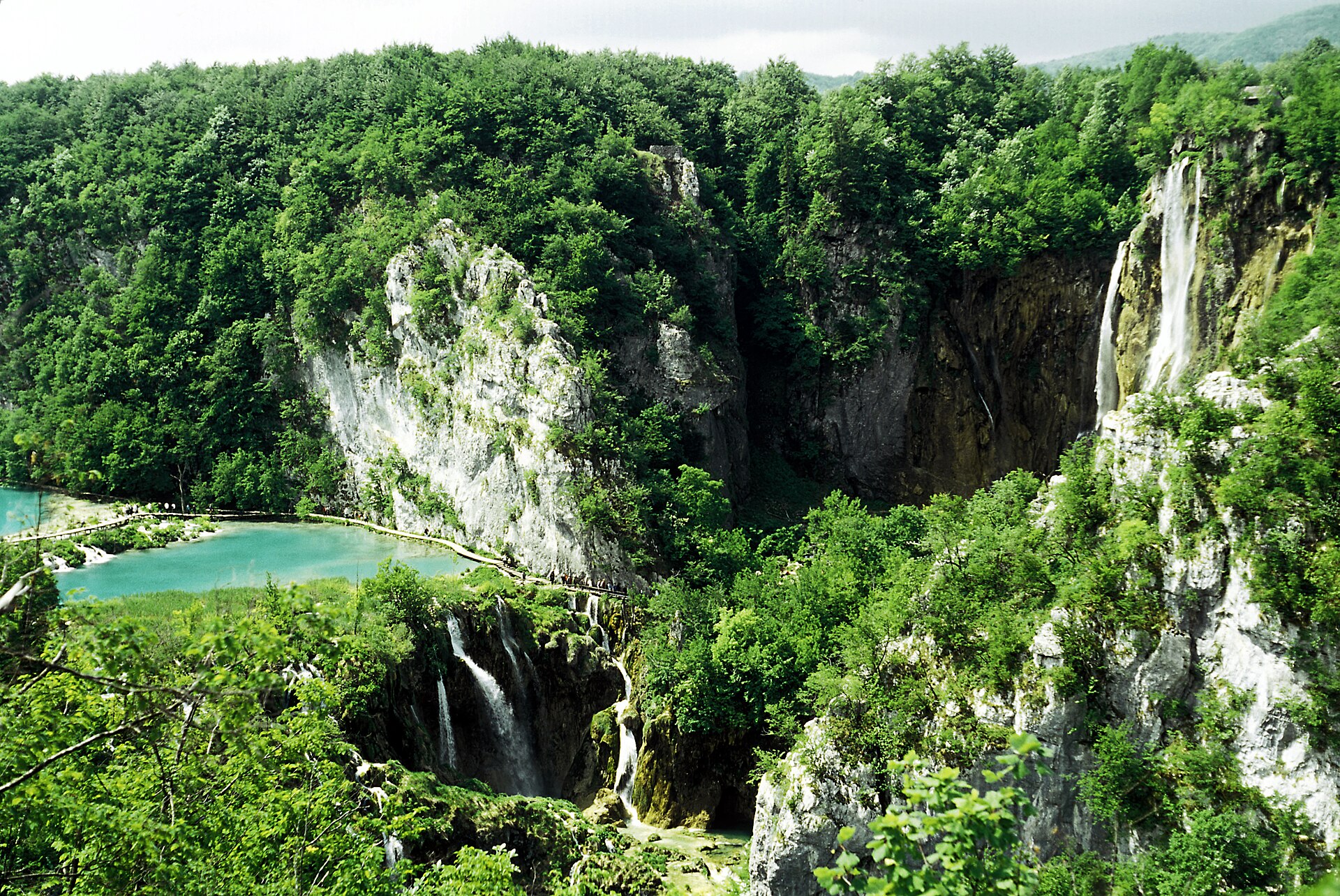
Plitvice Lakes is Croatia’s oldest and best-known national park: a chain of sixteen terraced lakes in the wooded hills of Lika, linked by dozens of waterfalls and crossed by wooden boardwalks laid just above the water. The colours shift from turquoise to green and grey with the light and the season, and the scale of the place only becomes clear once you are walking through it.
It is also one of the busiest sights in the country, and a little planning makes a big difference. This guide explains how the park is laid out, which entrance and route to choose, when to go, how timed tickets work and the rules every visitor needs to know, starting with the one that surprises people most: you cannot swim in the lakes.
Plitvice Lakes at a glance
- Best for: waterfalls, lake scenery and easy, well-marked walking on boardwalks and forest paths.
- How long: a full day covers the highlights; two days let you see the Upper and Lower Lakes without rushing.
- When to go: May, June, September and October for water, colour and fewer crowds than midsummer.
- Getting there: about two hours by road or bus from Zagreb, and roughly the same from Zadar.
- Book ahead: tickets are sold for a set date, entrance and time slot, and summer slots sell out.
- Key rule: no swimming anywhere in the park, and stay on the marked trails.
How the park works
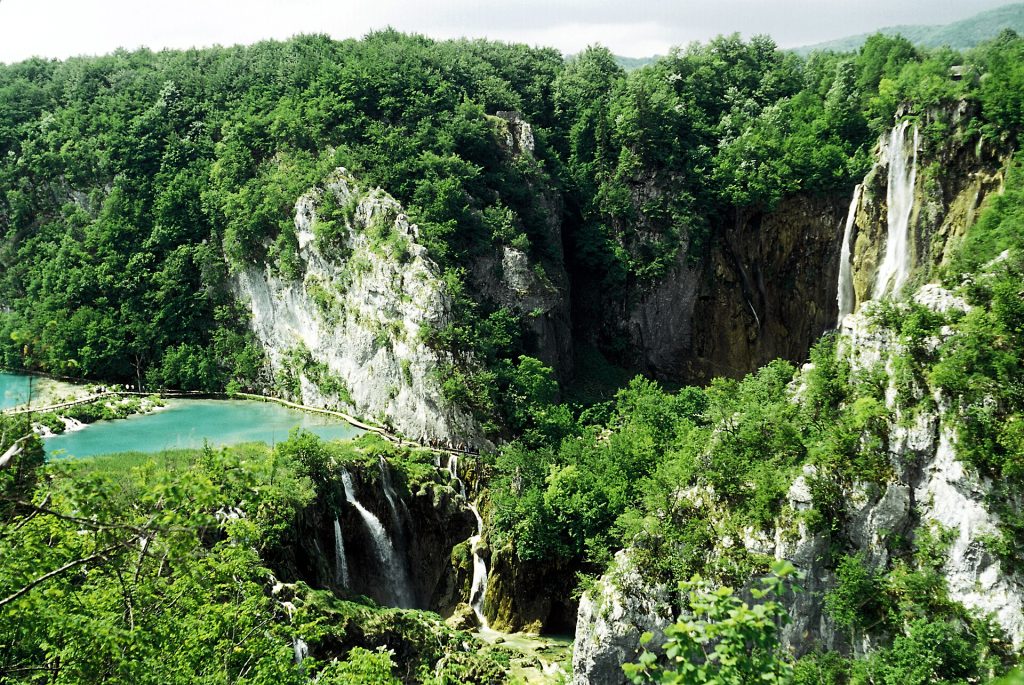
The national park was established in 1949 and covers just under 300 square kilometres, most of it forest. UNESCO added it to the World Heritage List in 1979 and approved an extension of the protected area in 2000. The lakes themselves occupy only a small part of the park, strung along a valley that drops steadily from south to north.
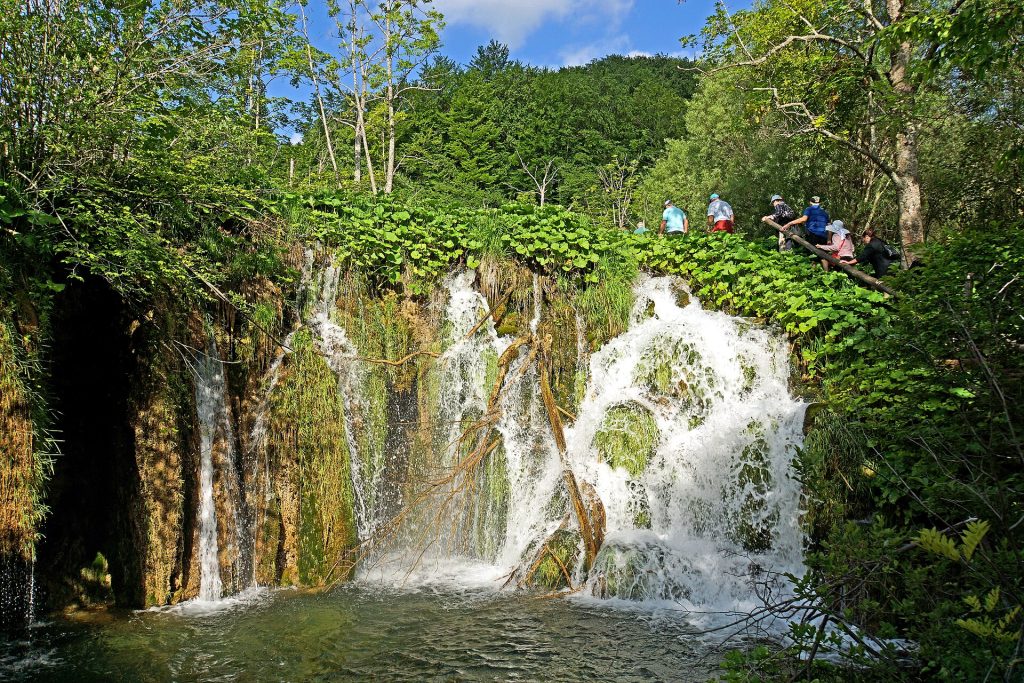
What makes Plitvice unusual is tufa (also called travertine), a porous rock formed when calcium carbonate settles out of the water onto moss and algae. Over thousands of years these deposits have built natural dams, or barriers, between the lakes, and the water spills over them in cascades. The barriers are still growing, which is why touching or walking on them is forbidden.
The lakes form two groups:
- The Upper Lakes: twelve lakes in a wider, gentler basin of forest and dolomite, with many small falls and long boardwalk sections. Prošćansko jezero is the highest, and Galovac and its cascades are among the prettiest stretches.
- The Lower Lakes: four lakes in a narrower limestone canyon with steep walls, ending at Veliki slap, the Great Waterfall. At around 78 metres it is usually described as the highest waterfall in Croatia. Below it the water leaves the park as the Korana river.
Between the two groups sits Kozjak, the largest lake, which you cross by electric boat on most routes.
Entrance 1 or Entrance 2
The park has two main entrances on the main road that runs along its eastern side, a few kilometres apart, plus a smaller auxiliary ticket point called Flora near Entrance 2. Your ticket is tied to one entrance, so decide before you book.
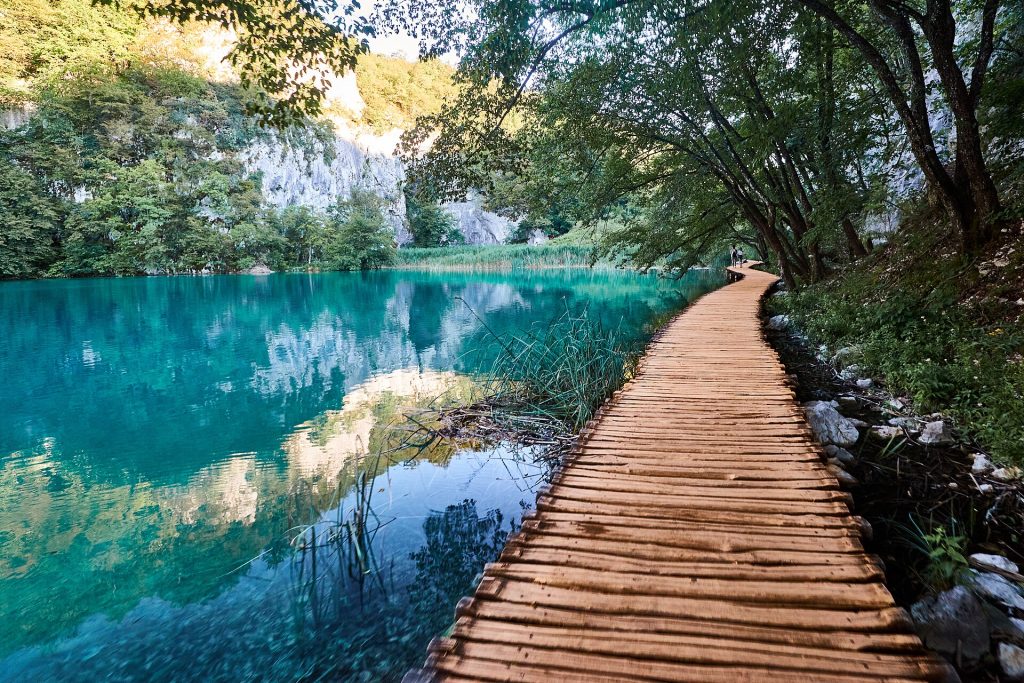
Entrance 1 (the northern one) is closest to the Lower Lakes and Veliki slap. Within minutes of the gate you reach the cliff-top viewpoint, the classic postcard shot looking down over the boardwalks. It is the busier entrance.
Entrance 2 (the southern one) is closer to Kozjak and the Upper Lakes. Routes from here usually start with a boat or train ride and save the Lower Lakes for later in the day.
With only a few hours, Entrance 1 gives you the famous views fastest. For a full day, both work well.
The main walking routes
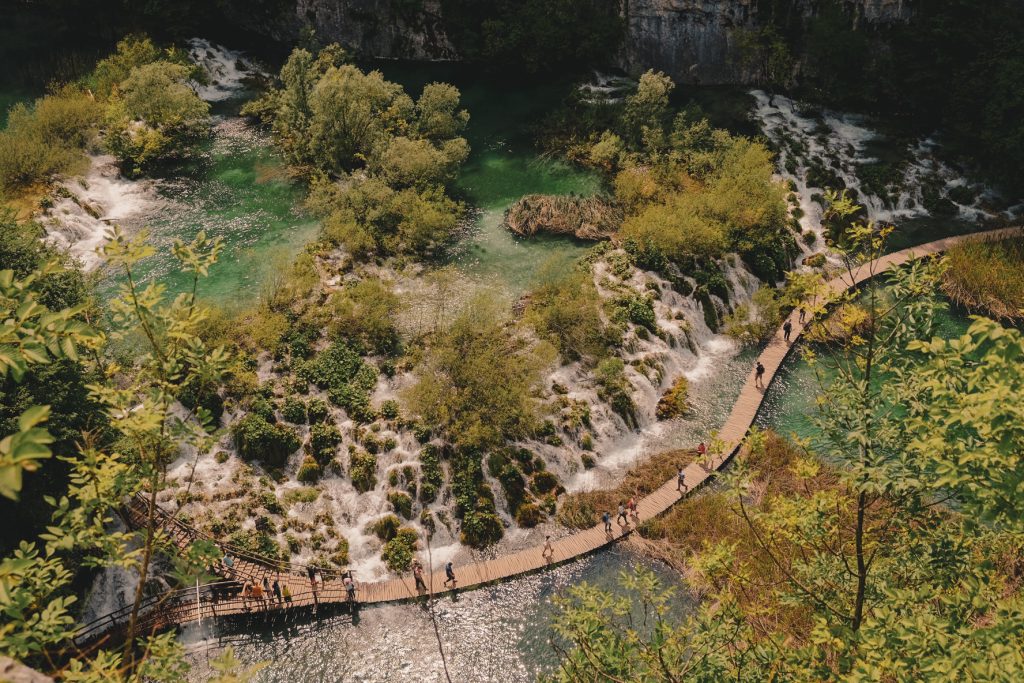
The park offers a set of signposted tour programmes, marked by letters on maps and signboards. Routes A, B and C start at Entrance 1; E, F and H start at Entrance 2; and K, the full circuit, can be started from either. Lengths and times below are the park’s own estimates.
- Program A (Entrance 1, about 3.5 km, 2 to 3 hours): a loop through the Lower Lakes to Veliki slap and back along the canyon rim. Good for a short stop.
- Program B (Entrance 1, about 4 km, 3 to 4 hours): the Lower Lakes plus a boat ride across Kozjak and the panoramic train back. A relaxed half-day.
- Program C (Entrance 1, about 8 km, 4 to 6 hours): the most recommended full-day route. It covers the Lower Lakes, crosses Kozjak by boat, walks the Upper Lakes and returns by train.
- Program H (Entrance 2, about 8.9 km, 4 to 6 hours): effectively the mirror of C. It begins with the train to the top of the Upper Lakes, walks down through them, crosses Kozjak by boat and finishes in the Lower Lakes canyon before returning towards Entrance 1.
- Program K (either entrance, about 18.3 km, 6 to 8 hours): the full loop of both lake groups on foot.
The shorter Entrance 2 programmes, E and F, focus mainly on the Upper Lakes and Kozjak. Check the current map when you book, as sections can close in winter.
Boats and the panoramic train
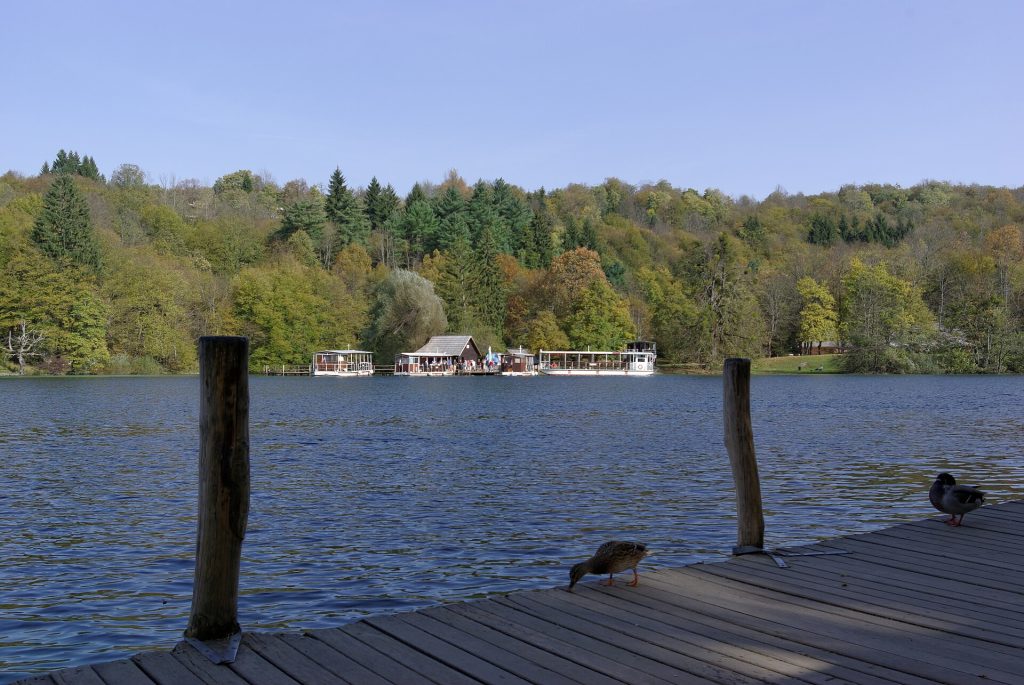
Two transport services are included in the ticket and are part of most routes. Quiet electric boats cross Lake Kozjak between landing points near Entrance 1, the middle of the lake and Entrance 2. Panoramic trains (in practice, road trains on tyres) run along the eastern edge of the park, linking the entrances with the top of the Upper Lakes.
Both save a lot of walking, but at peak times you may queue for half an hour or more for each. Build that into your day, or choose a route that walks the lake shore instead. In winter the boats and trains may run a reduced timetable or stop entirely depending on ice and snow, so check before you go.
When to go
- Spring (April to June): snowmelt and rain mean the fullest waterfalls, and the woods are fresh green. May and June are a strong choice.
- Summer (July and August): the longest opening hours but also the heaviest crowds, with queues on the narrow boardwalks and at the boats. Arrive at the first slot of the morning or come late in the afternoon.
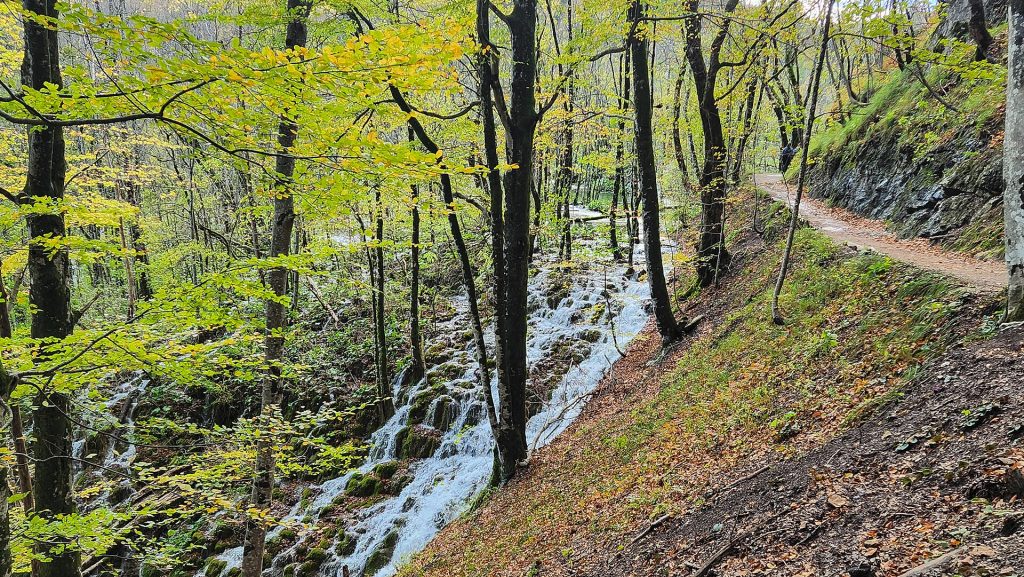
- Autumn (September to November): fewer people, mild days in September and beech and maple woods turning gold and red in October. Many regulars rate it the best season.
- Winter (December to March): snow and frozen falls make it beautiful and very quiet, but some trails, boats and trains may close, and boardwalks can be icy. Wear boots with grip.
Midweek is noticeably quieter than weekends.
Booking tickets
Plitvice uses timed entry. When you buy a ticket online through the park’s official ticketing site, you choose the date, the entrance and an arrival time slot, and you need to arrive within that window. You will not be let in early, and the ticket is valid only at the entrance you picked.
Prices vary by season, with the summer months the most expensive, and tickets for a second consecutive day are available. Children and students pay reduced rates. Ticket desks at the entrances still sell tickets on the day if slots remain, but in summer that is a gamble, especially for morning entry. Book online a few days ahead in high season, buy only from the official park site or a reputable tour operator, and check current prices and times before you travel.
Parking at the entrances is paid separately.
Park rules
The park authority enforces its rules, and rangers can fine visitors who break them. The most important ones:
- No swimming: swimming in the lakes is strictly prohibited, however tempting the water looks on a hot day. Paddling and wading on the tufa are not allowed either.
- Stay on the marked trails: do not leave the boardwalks or paths, and do not climb on the tufa barriers, which are fragile and still forming.
- Do not feed the animals: this includes the fish and the ducks.
- Dogs on a lead: dogs are allowed but must be kept on a leash.
- No fishing, camping, fires or picking plants: leave everything as you find it, and take your rubbish out with you.
- Drones: do not fly one without explicit permission from the park; treat the park as a no-drone zone.
Boardwalks are narrow, so step aside to take photos.
Getting there and where to stay
Plitvice lies inland in central Croatia, roughly between Zagreb and Zadar. By car from Zagreb it is about 140 km and around two hours, mainly via Karlovac; from Zadar allow a similar time. Coming from Split, expect a longer drive or a bus journey of around four hours or more.
Buses between Zagreb and Zadar or Split stop at both main entrances, so the park also works without a car.
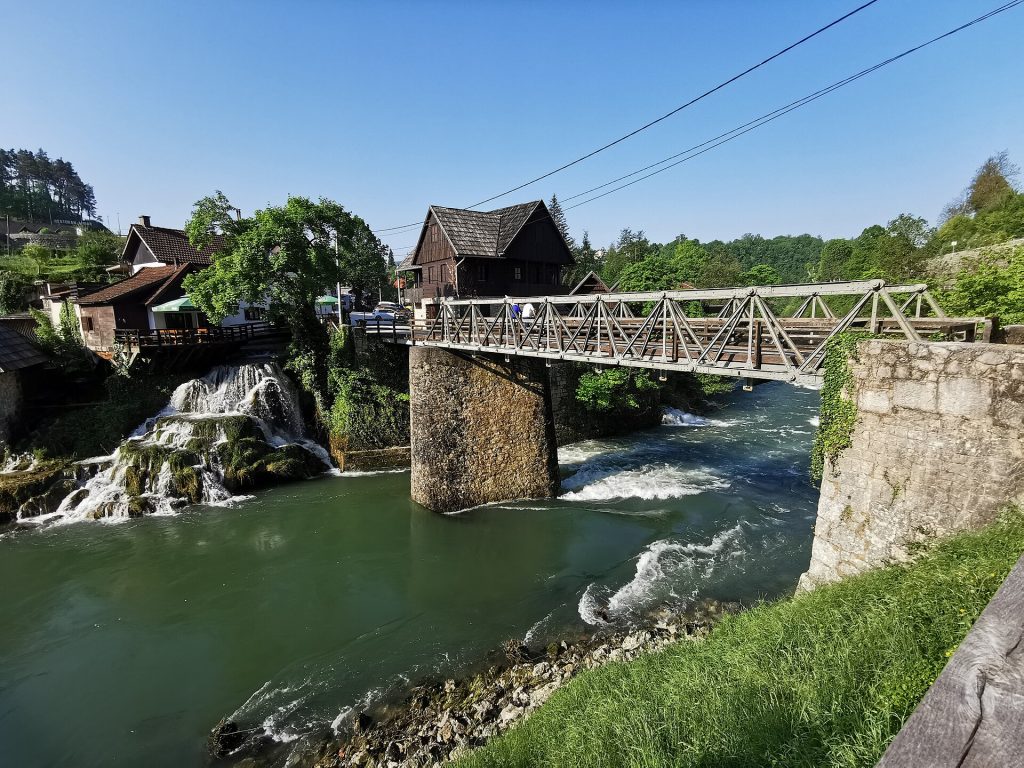
Staying nearby is the best way to beat the crowds. The park runs several hotels near Entrance 2, and there are many guesthouses and private rooms in villages such as Mukinje, Jezerce and Rakovica. On the way north, stop at Rastoke, a cluster of old watermills and small falls where the Slunjčica meets the Korana in the town of Slunj.
Practical tips
- Shoes: wear shoes with grip, as boardwalks get slippery when wet.
- Food and water: snack bars are found only at the main hubs, so carry water and snacks.
- Weather: the park is cooler than the coast. Bring a layer and a waterproof.
Plan your trip to Plitvice Lakes
- Where to stay: tickets and tours on Tiqets · activities on Klook
- Tours and tickets: tickets and tours on Tiqets · activities on Klook
- Arriving by plane: pre-book an airport transfer with Welcome Pickups
- Road trip: compare car hire on Localrent
- Mobile data: get a travel eSIM from Airalo
Some of these are affiliate links: if you book through them we may earn a small commission, at no extra cost to you.
Planning a bigger trip? See our guide to the 25 best places to visit in Europe, from city breaks to fjords.
Keep exploring
- Best Cities in Croatia: A City-by-City Guide and Where to Stay
- Croatia’s Quietest Islands: 8 Secluded Escapes and How to Reach Them
- Five Hidden Gems in Croatia’s Quiet Interior
Frequently asked questions
Can you swim at Plitvice Lakes?
No. Swimming is strictly prohibited in all of the lakes, and so is wading or stepping onto the tufa barriers. If you want a swim, save it for the coast or a designated bathing spot outside the park.
Do you need to book Plitvice tickets in advance?
In summer, yes. Tickets are sold for a specific date, entrance and time slot, and popular morning slots can sell out days ahead. Outside peak season you can often buy at the gate, but booking online is still the safer option.
How long do you need at Plitvice Lakes?
Plan on a full day, around five to six hours on site, to see both the Upper and Lower Lakes on Program C or H. A two to three hour visit covers the Lower Lakes and Veliki slap only.
Photos: Falk2, CC BY-SA 4.0, via Wikimedia Commons; Anil Öztas, CC BY-SA 4.0, via Wikimedia Commons; Twiggiez, CC BY-SA 4.0, via Wikimedia Commons; Berthold Werner, CC BY-SA 3.0, via Wikimedia Commons; OrionCro, CC BY-SA 4.0, via Wikimedia Commons; Dennis G. Jarvis, CC BY-SA 2.0, via Wikimedia Commons; Mnalis, CC BY-SA 4.0, via Wikimedia Commons.